Reimagining an in app messaging experiecne to address ghosting
The Date Conscious Suite: Learning from a Strategic Pivot
Client
Inner Circle - 2022
Inner Circle - 2022
Sector
Consumer app - Dating
Consumer app - Dating
Role
Product Design Lead (research, concepts, delivery, testing, iteration) and Project Co-Lead (strategy, team coordination, stakeholder communication). Worked with cross-functional team including Marketing, Engineering, Data, Research, and Customer Support over 5 months in 2022.
Product Design Lead (research, concepts, delivery, testing, iteration) and Project Co-Lead (strategy, team coordination, stakeholder communication). Worked with cross-functional team including Marketing, Engineering, Data, Research, and Customer Support over 5 months in 2022.
The TLDR
Inner Circle users were drowning in conversations that went nowhere. 20+ open chats, but most going cold after just 2 messages. Leadership wanted a "big marketable feature" to address ghosting and drive word-of-mouth growth. I pushed back on the brief and proposed we validate the core hypothesis with a phased approach and built-in checkpoints before committing significant development resources.
The challenge:
Balance competing priorities: create a marketable anti-ghosting solution while genuinely improving user experience, and test a high-risk product change (limiting active conversations for paid users) without sacrificing short-term revenue. The strategic tension was that "marketable" and "genuinely useful" don't always align; I wanted to ensure we were solving real user problems, not just chasing hollow buzz.
The outcome:
When early data showed our solution added friction without value, I made the call to pivot one month before global launch; repackaging developed features as the "Date Conscious Suite." that improved user satisfaction and engagement.
Advocated for MVP-first approach with Go/No-Go checkpoint, which prevented launching a solution that tested poorly
Pivoted from restrictive model (limit conversations) to additive features (pinned conversations, message requests, closure feedback) that addressed core user needs
7% increase in phone number exchanges, 4% increase in product satisfaction (68% → 72%), 66.7% increase in average conversation length (2.1 → 3.5 messages)
Built internal buy-in for rethinking free vs. paid experience, launching follow-up experiments grounded in user needs rather than marketing goals
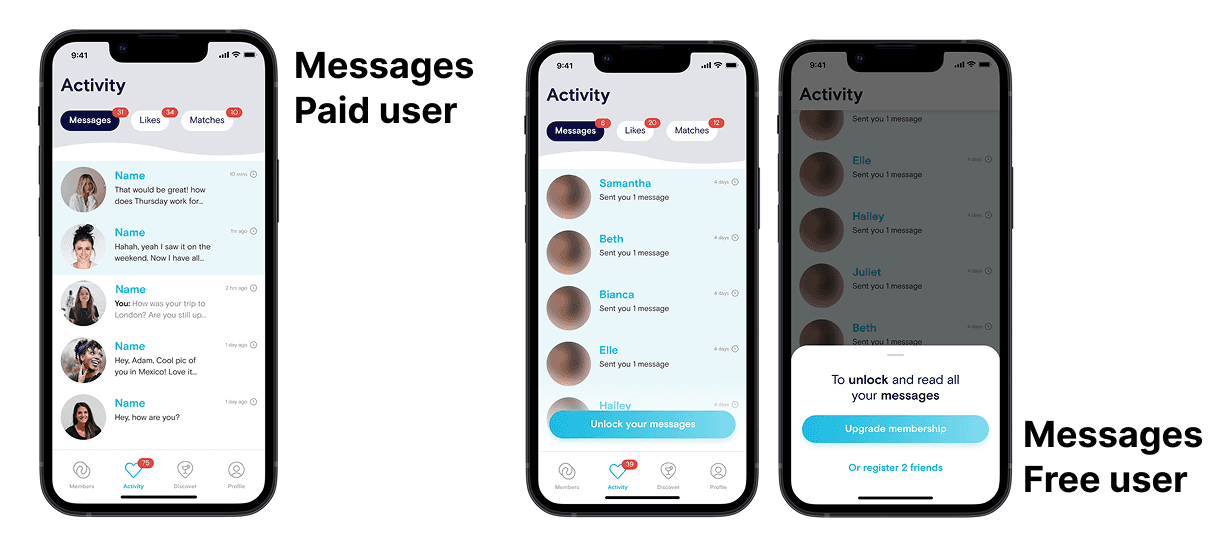
The existing messages interface for paid users ( L- open access) and free users (R - locked)
Background —
2022 marked 10 years of online dating, and with it the rise of bad behaviours like breadcrumbing and ghosting. The business wanted to tackle ghosting( an industry-wide problem) in a way that would generate buzz and improve retention.
Inner Circles users were over it, they had 20+ "active" chats but most conversations died after 2 messages. Average conversation length was 2.1 messages. Product satisfaction sat at 68%.
Our freemium model added complexity: free members could send first messages but couldn't read replies, while paid members had unlimited messaging but could only realistically talk to other paying users. This imbalanced ecosystem meant conversations stalled before they started.
2022 marked 10 years of online dating, and with it the rise of bad behaviours like breadcrumbing and ghosting. The business wanted to tackle ghosting( an industry-wide problem) in a way that would generate buzz and improve retention.
Inner Circles users were over it, they had 20+ "active" chats but most conversations died after 2 messages. Average conversation length was 2.1 messages. Product satisfaction sat at 68%.
Our freemium model added complexity: free members could send first messages but couldn't read replies, while paid members had unlimited messaging but could only realistically talk to other paying users. This imbalanced ecosystem meant conversations stalled before they started.
Challenge —
My challenge was to create a marketable feature that would generate word-of-mouth growth, retention and engagement. While genuinely improving user experience by addressing ghosting; a problem affecting the entire dating industry.
But there was tension in the brief: "deliver a campaign-worthy feature in one quarter." I knew this created pressure to build something big and flashy rather than solve the core user problem.
My challenge was to create a marketable feature that would generate word-of-mouth growth, retention and engagement. While genuinely improving user experience by addressing ghosting; a problem affecting the entire dating industry.
But there was tension in the brief: "deliver a campaign-worthy feature in one quarter." I knew this created pressure to build something big and flashy rather than solve the core user problem.
Approach —
Through surveys, interviews and conversation data analysis, I identified the core jobs users were trying to solve:
Knowing if someone is actually interested,
Ending things respectfully without guilt and,
Organizing messages to know which ones matter.
I proposed a bold hypothesis:
Opening messages for all users while limiting active conversations to 5 would increase conversation quality, boost retention, and create a unique solution to ghosting.
Before moving forward, I surveyed our global user base:
40% of paid users said they'd be open to limiting active conversations if it led to more meaningful replies and real dates. - A risky bet.
We would measure success by:
2x increase in average conversation length (2.1 → 4 messages),
15% increase in phone number exchanges,
maintained 68% satisfaction despite major changes,
and improved Day 1, Week 1, Week 2 retention.
The delivery roadmap:
Story mapping: Break the epic into smaller releases
MVP-first development: Start small and iterate
Start with the riskiest part: limiting paid users
Test market: Validate with a controlled audience
Frequent feedback loops: Interviews and surveys every sprint
Weekly syncs: With Marketing on messaging
Post launch improvements: 1 month follow up for improvements
A Plan B — Go/No Go date
Through surveys, interviews and conversation data analysis, I identified the core jobs users were trying to solve:
Knowing if someone is actually interested,
Ending things respectfully without guilt and,
Organizing messages to know which ones matter.
I proposed a bold hypothesis:
Opening messages for all users while limiting active conversations to 5 would increase conversation quality, boost retention, and create a unique solution to ghosting.
Before moving forward, I surveyed our global user base:
40% of paid users said they'd be open to limiting active conversations if it led to more meaningful replies and real dates. - A risky bet.
We would measure success by:
2x increase in average conversation length (2.1 → 4 messages),
15% increase in phone number exchanges,
maintained 68% satisfaction despite major changes,
and improved Day 1, Week 1, Week 2 retention.
The delivery roadmap:
Story mapping: Break the epic into smaller releases
MVP-first development: Start small and iterate
Start with the riskiest part: limiting paid users
Test market: Validate with a controlled audience
Frequent feedback loops: Interviews and surveys every sprint
Weekly syncs: With Marketing on messaging
Post launch improvements: 1 month follow up for improvements
A Plan B — Go/No Go date
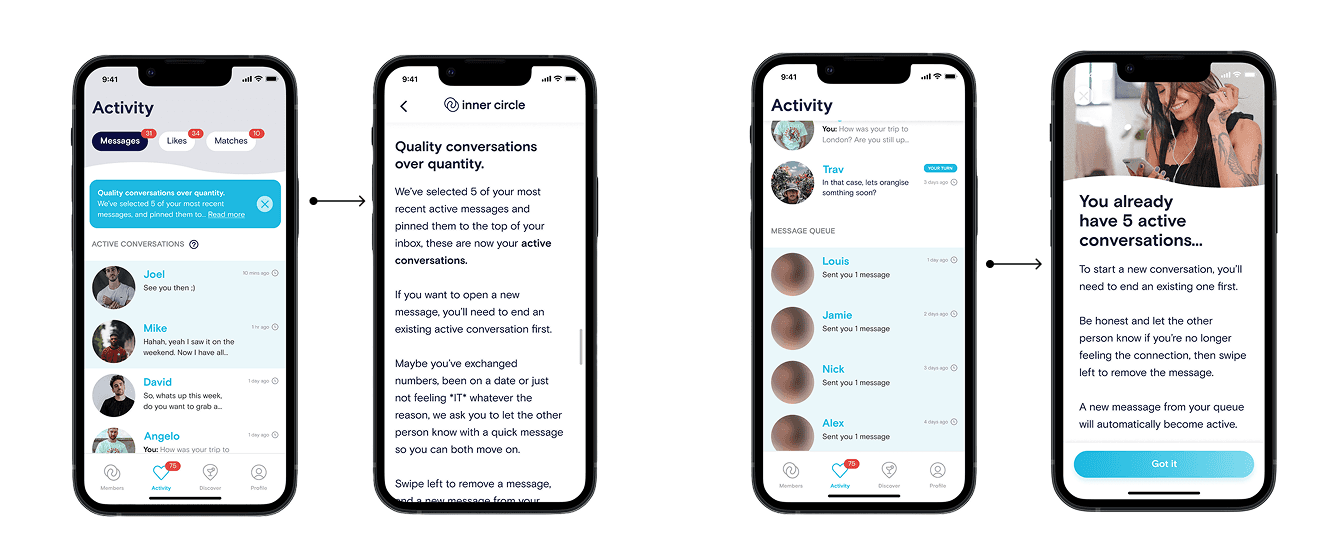
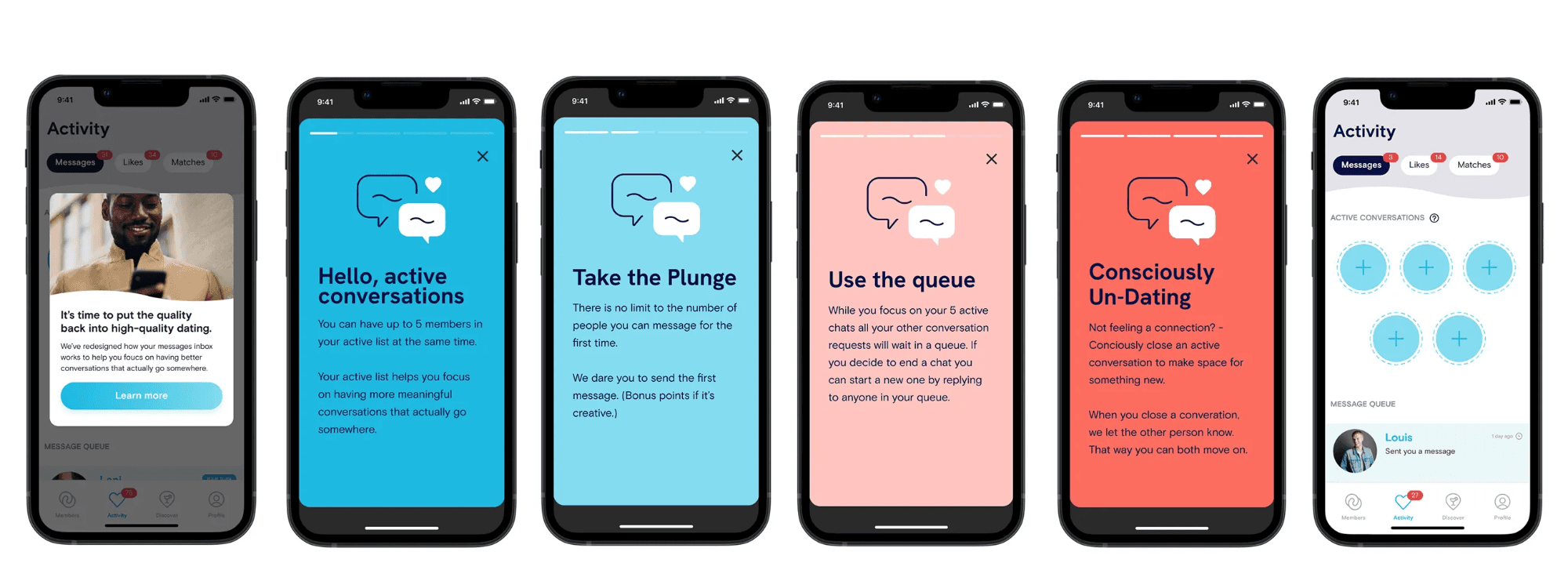
(Above) (L) The basic MVP concept: Active conversations and messaging queue (R) A message reinforcing the concept (Below) Education screens for new test users (new and existing paying users in another test city)


(L) Start an active conversation (R) Ending an active conversation with a reason
Results —
Testing and learning fast
Phase 1 (MVP): We launched with 10K paid users, limiting them to 5 most recent active conversations with a message queue. Within two weeks, data showed friction without payoff; users were frustrated they couldn't choose which conversations to prioritize.
Phase 2 (Iteration): I redesigned the UI to let users choose their active conversations and added a "close conversation with reason" feature to promote accountability. User feedback revealed the core issue: they still didn't feel the value of limited chats without increased activity from free users.
We were testing the constraint (limited conversations) before testing the benefit (open messaging network). I flagged this as a critical risk; limiting messages alone wouldn't fix ghosting unless free users could also engage.
Phase 3 (Addressing the root cause): I pushed to test open messaging more broadly, but due to revenue concerns and technical constraints, we could only add 1 active conversation for free users. Activity increased, but not enough.
The pattern I saw: Each phase validated pieces of the hypothesis, but we were testing in the wrong order. We needed the benefit (network activity) before the constraint (limits) would feel valuable.
What we learned through testing
Phase and Goal | Key Change | What We Learned |
|---|---|---|
PRE LAUNCH: | - Feedback survey and in app information | - 40% of paid users |
MVP: | - Limit to 5 most recent active convos | - Added friction without payoff. |
PHASE 2: | - New UI | Users don't feel the value of limited chats without added activity benefits of open message network |
PHASE 3: | - 1 active convo for free users | Activity up from including free users in test, but not enough and too late |
Testing and learning fast
Phase 1 (MVP): We launched with 10K paid users, limiting them to 5 most recent active conversations with a message queue. Within two weeks, data showed friction without payoff; users were frustrated they couldn't choose which conversations to prioritize.
Phase 2 (Iteration): I redesigned the UI to let users choose their active conversations and added a "close conversation with reason" feature to promote accountability. User feedback revealed the core issue: they still didn't feel the value of limited chats without increased activity from free users.
We were testing the constraint (limited conversations) before testing the benefit (open messaging network). I flagged this as a critical risk; limiting messages alone wouldn't fix ghosting unless free users could also engage.
Phase 3 (Addressing the root cause): I pushed to test open messaging more broadly, but due to revenue concerns and technical constraints, we could only add 1 active conversation for free users. Activity increased, but not enough.
The pattern I saw: Each phase validated pieces of the hypothesis, but we were testing in the wrong order. We needed the benefit (network activity) before the constraint (limits) would feel valuable.
What we learned through testing
Phase and Goal | Key Change | What We Learned |
|---|---|---|
PRE LAUNCH: | - Feedback survey and in app information | - 40% of paid users |
MVP: | - Limit to 5 most recent active convos | - Added friction without payoff. |
PHASE 2: | - New UI | Users don't feel the value of limited chats without added activity benefits of open message network |
PHASE 3: | - 1 active convo for free users | Activity up from including free users in test, but not enough and too late |
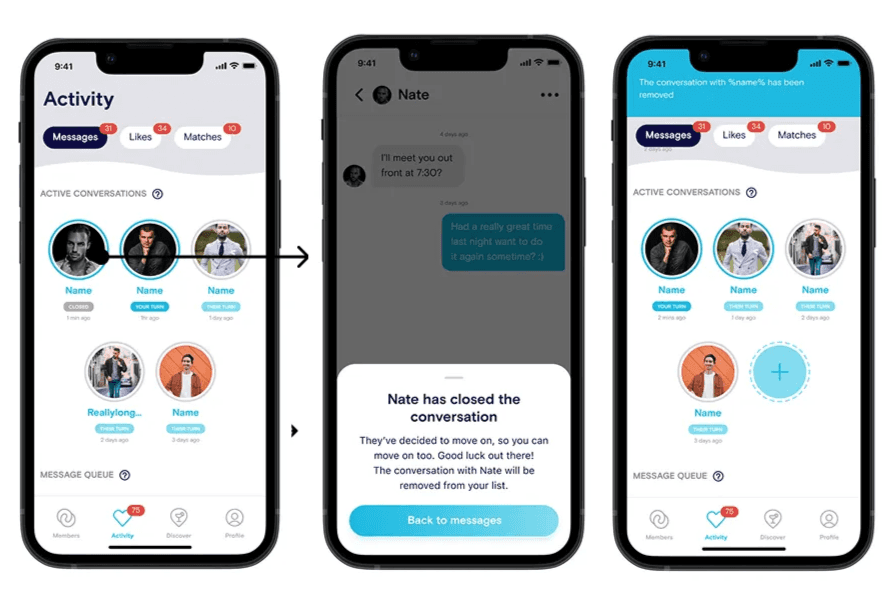
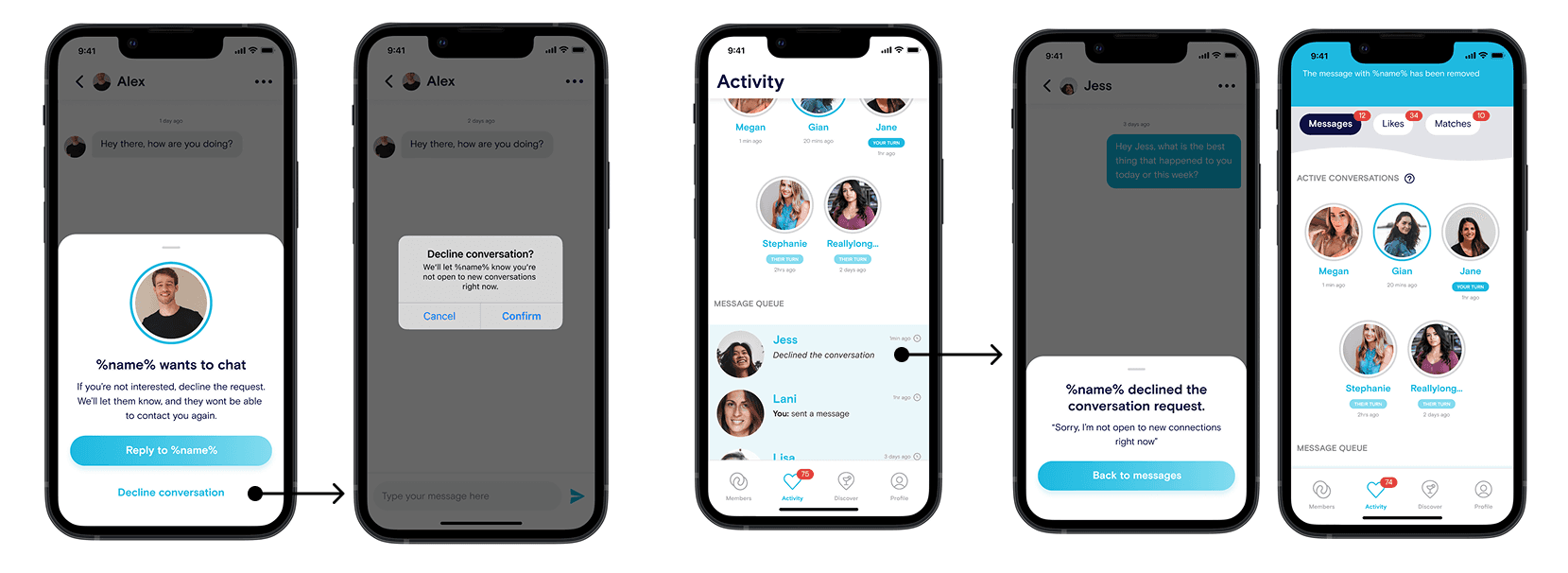
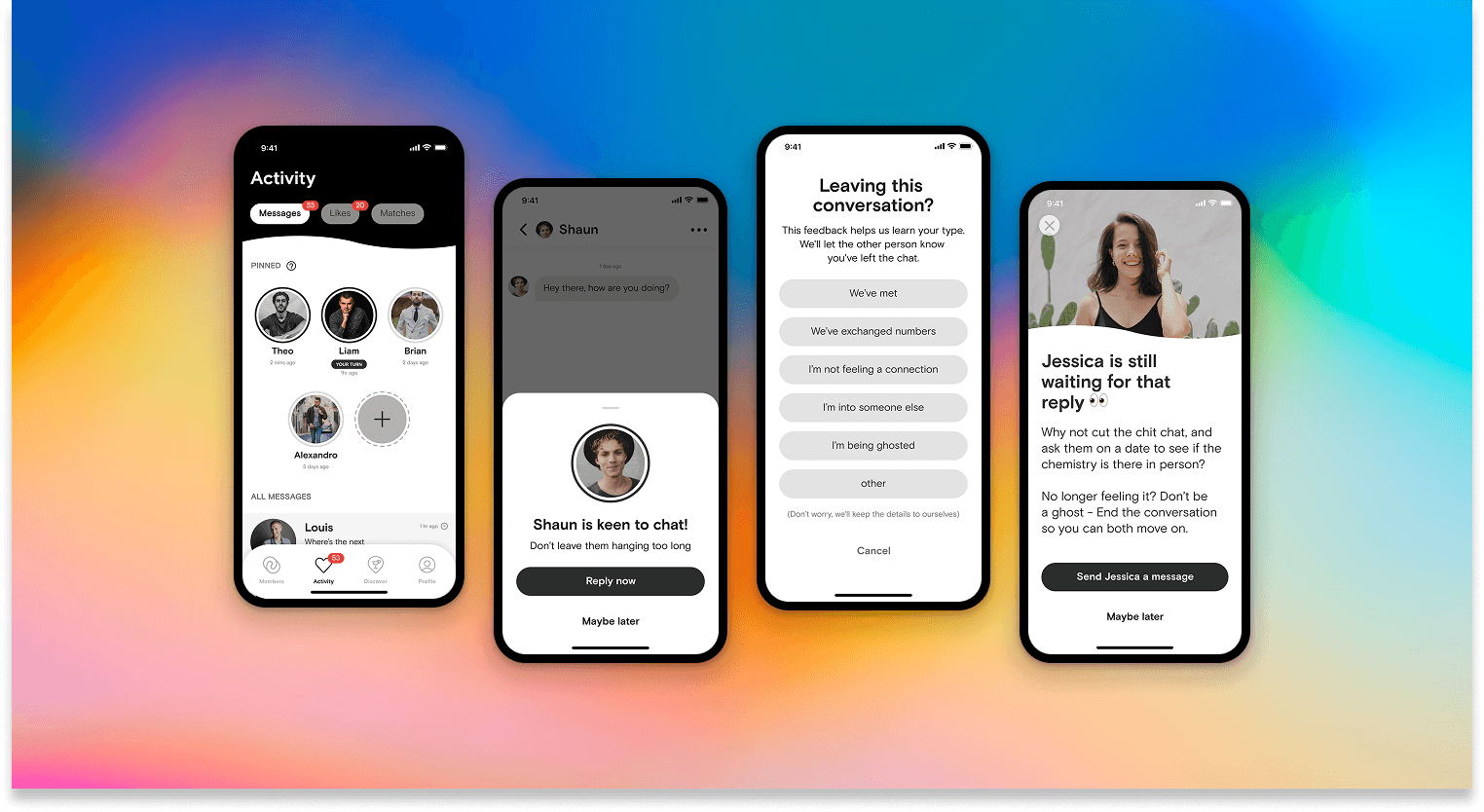
Above:- Declining a new conversation request & What the other person see’s when their message is declined. Below: “Closure messages” = What person B sees when a conversation has been “closed” with them.
Outcome —
With only marginal improvement in phone number exchanges,
I made the call, to halt the rollout, and create a pivot plan.
Repackaging for impact:
We removed hard conversation limits and released the developed feature set as the "Date Conscious Suite" a softer approach to combat ghosting while maintaining one-message access for free users.
We rolled back changes in the test market and communicated openly via email and in-app about trying something that didn't work, listening to feedback, and making improvements. This transparency increased user trust.
The pivot allowed us to address the core job stories in a less restrictive way while reusing already-developed features:
Pinned Conversations
(paid users could prioritize top 5 active conversations),Message Requests with Decision feedback
(Prompts to accept or pass on a new message request)Anti-Ghosting Reminders
(gentle nudges for existing conversations before starting new ones),Conversation Closure with Feedback
(tools for ending conversations respectfully with reasons shared to improve future matches),One Open Message for Free Users
(improved their experience and contributed to network activity).
The impact: 6 weeks after global launch:
7% increase in phone number exchanges (one every 10.5 seconds)
4% increase in product satisfaction (68% → 72%)
66.7% increase in average conversation length (2.1 → 3.5 messages)
Positive reception of new message UI across global user base
Successful marketing campaign generated word-of-mouth buzz
While not all features rolled out globally, the project influenced future messaging improvements and strengthened internal alignment on addressing core user needs. The "close conversation with feedback" feature gave us qualitative data on why users ended chats, helping improve match recommendations.
With only marginal improvement in phone number exchanges,
I made the call, to halt the rollout, and create a pivot plan.
Repackaging for impact:
We removed hard conversation limits and released the developed feature set as the "Date Conscious Suite" a softer approach to combat ghosting while maintaining one-message access for free users.
We rolled back changes in the test market and communicated openly via email and in-app about trying something that didn't work, listening to feedback, and making improvements. This transparency increased user trust.
The pivot allowed us to address the core job stories in a less restrictive way while reusing already-developed features:
Pinned Conversations
(paid users could prioritize top 5 active conversations),Message Requests with Decision feedback
(Prompts to accept or pass on a new message request)Anti-Ghosting Reminders
(gentle nudges for existing conversations before starting new ones),Conversation Closure with Feedback
(tools for ending conversations respectfully with reasons shared to improve future matches),One Open Message for Free Users
(improved their experience and contributed to network activity).
The impact: 6 weeks after global launch:
7% increase in phone number exchanges (one every 10.5 seconds)
4% increase in product satisfaction (68% → 72%)
66.7% increase in average conversation length (2.1 → 3.5 messages)
Positive reception of new message UI across global user base
Successful marketing campaign generated word-of-mouth buzz
While not all features rolled out globally, the project influenced future messaging improvements and strengthened internal alignment on addressing core user needs. The "close conversation with feedback" feature gave us qualitative data on why users ended chats, helping improve match recommendations.

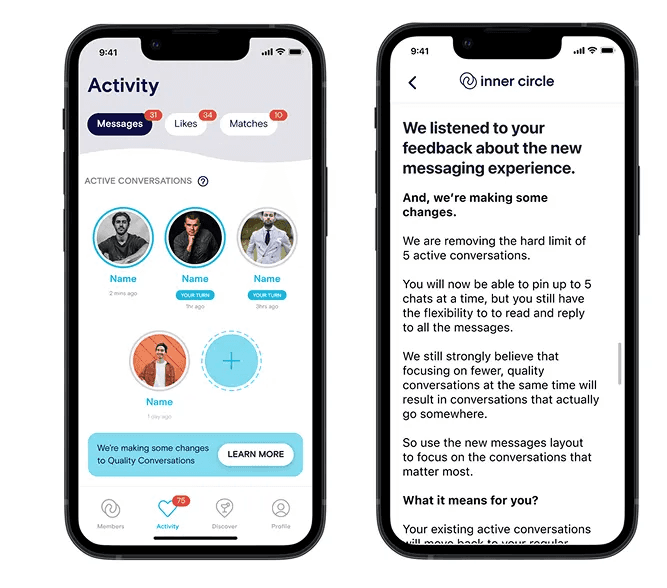
(L) The Re-packaged "Date Conscious Suite" (R) Rollback message
Takeaway —
Validating the riskiest assumption first.
We tested the constraint (limited conversations) with our riskiest segment (paying users) before validating the benefit (open messaging network). This was backwards. If I could redo it, I would have pushed harder to test opening messages to free users earlier as it was a key aspect of the hypothesis.
If this wasn't possible, I would have changed the approach all together, rather than risking our core paying users.
The Go/No-Go checkpoint saved us from launching something that didn't work. In ambiguous, high-stakes projects, I now always build in decision points and Plan B options before starting development, and opt for a smaller iterative learn and refine approach.
Marketing timelines and product validation don't always align. When they conflict, I've learned to push back earlier and harder on unrealistic timelines that don't allow for proper validation.
Validating the riskiest assumption first.
We tested the constraint (limited conversations) with our riskiest segment (paying users) before validating the benefit (open messaging network). This was backwards. If I could redo it, I would have pushed harder to test opening messages to free users earlier as it was a key aspect of the hypothesis.
If this wasn't possible, I would have changed the approach all together, rather than risking our core paying users.
The Go/No-Go checkpoint saved us from launching something that didn't work. In ambiguous, high-stakes projects, I now always build in decision points and Plan B options before starting development, and opt for a smaller iterative learn and refine approach.
Marketing timelines and product validation don't always align. When they conflict, I've learned to push back earlier and harder on unrealistic timelines that don't allow for proper validation.