Balancing retention, engagement, and revenue in high-churn markets

Redesigning a Paywall Strategy
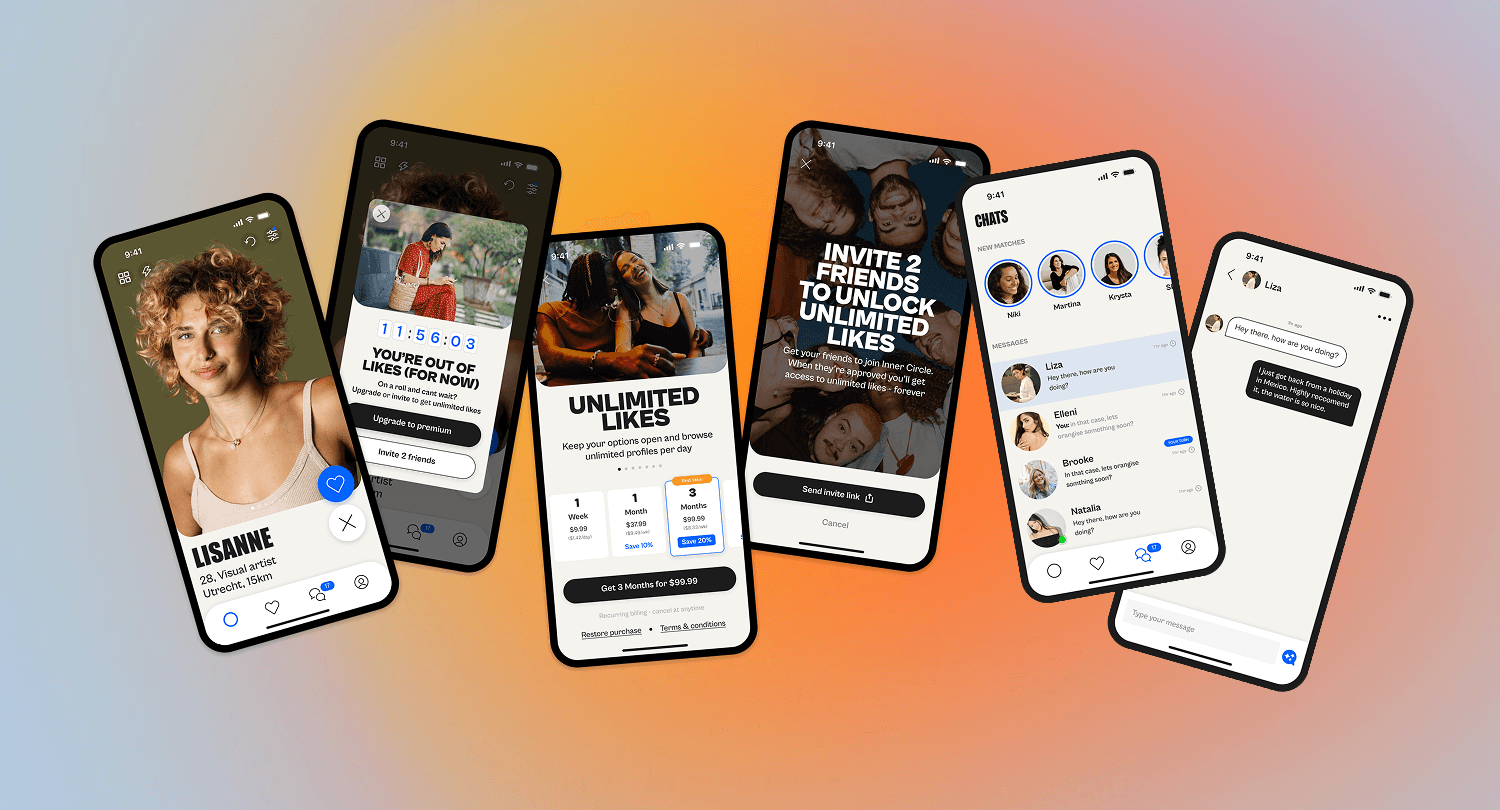
New Paywall screens
New Paywall screens
New Paywall screens

Client

Inner Circle - 2024

Inner Circle - 2024

Sector

Consumer lifestyle app (Dating)

Consumer lifestyle app (Dating)

Role

Lead Product Designer, responsible for end-to-end design; research, concept development, A/B testing, and iteration. Partnered closely with product, data, and engineering throughout the process.

Lead Product Designer, responsible for end-to-end design; research, concept development, A/B testing, and iteration. Partnered closely with product, data, and engineering throughout the process.

The TLDR

Inner Circle's legacy paywall locked messaging; effective for revenue, but a dealbreaker as competitors offered it free. I led the design of a new freemium model that shifted monetization to limiting likes instead, improving activation and retention in high-churn markets without sacrificing revenue.

The challenge:
Declining conversion and paid retention as user expectations shifted. Free users churned at the messaging paywall; paid users suffered from reduced activity as fewer people converted.

The outcome:
Timed like-limiting paywalls became the default for freemium users in our newer and high-churn markets, where activity and retention were important for building a strong network effect.

  • Time resets helped improve DAU, and sustained consistent activity

  • Opening messages, increased day 1 and week 1 retention


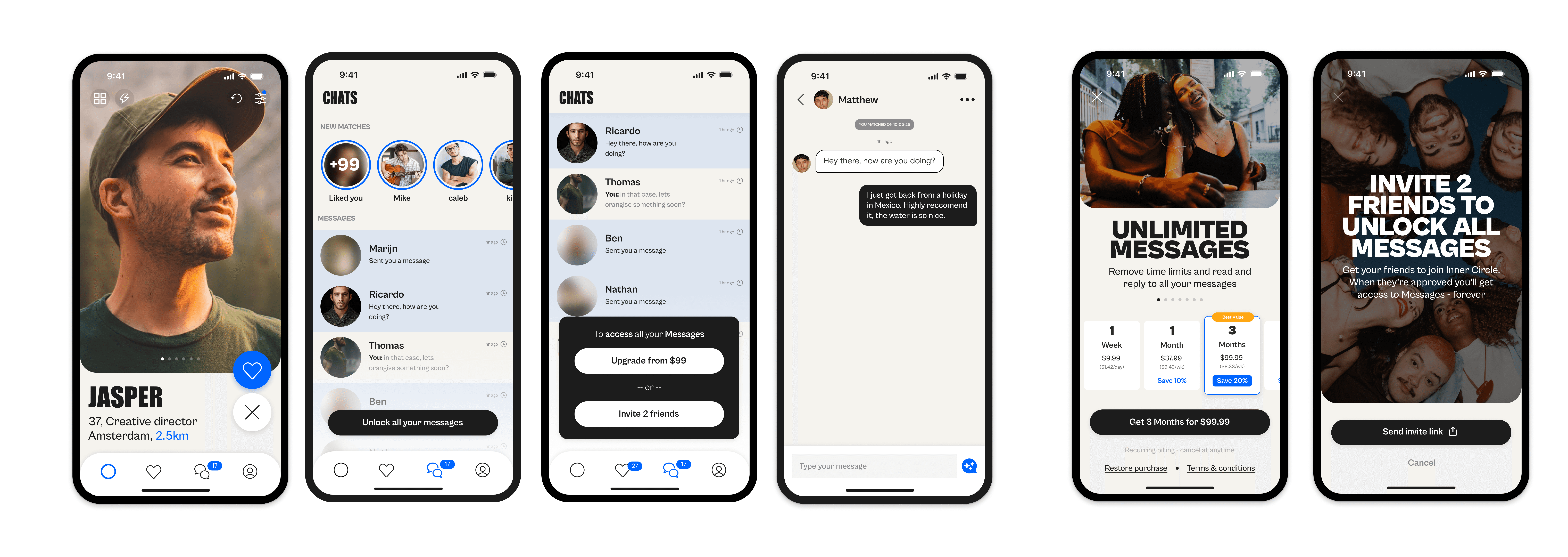
Standard paywall (messages locked)

Background —

Inner Circle is a global dating dating app (founded 2012) that historically monetized by locking messages behind a paywall. This worked well in the early days when swiping was novel, but as we expanded globally, user expectations shifted. Competitors were offering messaging for free, and our legacy model was blocking new users from experiencing the core value loop: like → match → message. We couldn't reach the DAU threshold needed for thriving networks in emerging markets, and both conversion and paid retention were declining.

Inner Circle is a global dating dating app (founded 2012) that historically monetized by locking messages behind a paywall. This worked well in the early days when swiping was novel, but as we expanded globally, user expectations shifted. Competitors were offering messaging for free, and our legacy model was blocking new users from experiencing the core value loop: like → match → message. We couldn't reach the DAU threshold needed for thriving networks in emerging markets, and both conversion and paid retention were declining.

Challenge —

Declining conversion and paid retention as user expectations shifted. Free users churned at the messaging paywall; often right after matching, frustrated they couldn't continue conversations.

Paid users were also impacted, as fewer free users converted, reducing overall messaging activity and match-to-message momentum. We needed a more sustainable model that improved activation, engagement, and retention without cannibalizing revenue.

Declining conversion and paid retention as user expectations shifted. Free users churned at the messaging paywall; often right after matching, frustrated they couldn't continue conversations.

Paid users were also impacted, as fewer free users converted, reducing overall messaging activity and match-to-message momentum. We needed a more sustainable model that improved activation, engagement, and retention without cannibalizing revenue.

Approach —

I started with willingness-to-pay studies (Van Westendorp + Conjoint analysis), user interviews, and churn survey analysis to understand what users actually valued. The research revealed that users wanted to message matches immediately to keep momentum going, and they wanted to explore the product before hitting a paywall.

I framed the problem through job stories and hypotheses, then designed and tested two core variations:
1. open messages with limited profile views vs.
2. open messages with limited likes.

I started with willingness-to-pay studies (Van Westendorp + Conjoint analysis), user interviews, and churn survey analysis to understand what users actually valued. The research revealed that users wanted to message matches immediately to keep momentum going, and they wanted to explore the product before hitting a paywall.

I framed the problem through job stories and hypotheses, then designed and tested two core variations:
1. open messages with limited profile views vs.
2. open messages with limited likes.

Open messages with matches (messages from non matches locked)

Results —
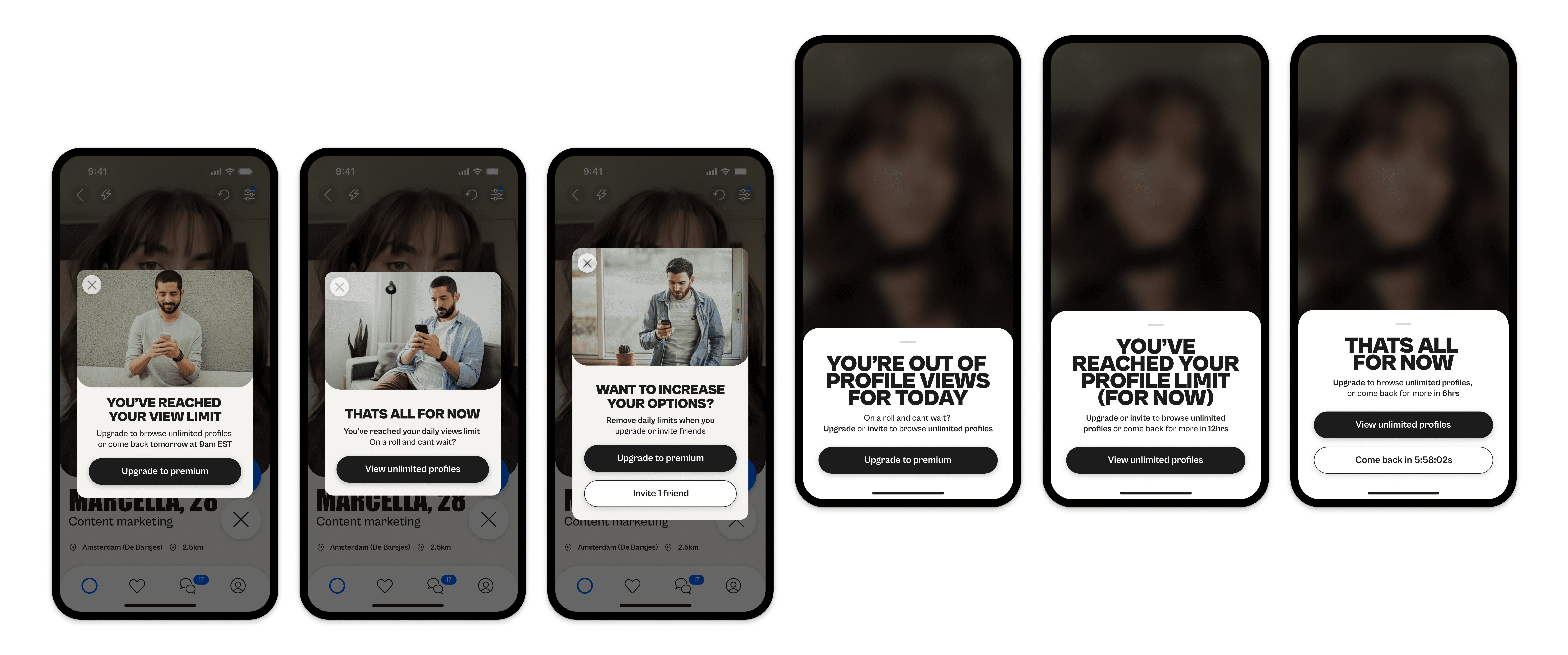
After initial tests showed like-limiting performed better, I refined the approach through multiple iterations; testing gender-specific limits, time-based resets, invite-based unlocks, and dynamic limits based on demographics and likelihood to pay.


What performed best

  • Dynamic limits: based on demographics and likelihood to pay

  • Clear, specific copy: explaining what resets and when

  • 12-hour resets: tied to the moment the user hit the paywall (not a fixed time)

After initial tests showed like-limiting performed better, I refined the approach through multiple iterations; testing gender-specific limits, time-based resets, invite-based unlocks, and dynamic limits based on demographics and likelihood to pay.


What performed best

  • Dynamic limits: based on demographics and likelihood to pay

  • Clear, specific copy: explaining what resets and when

  • 12-hour resets: tied to the moment the user hit the paywall (not a fixed time)

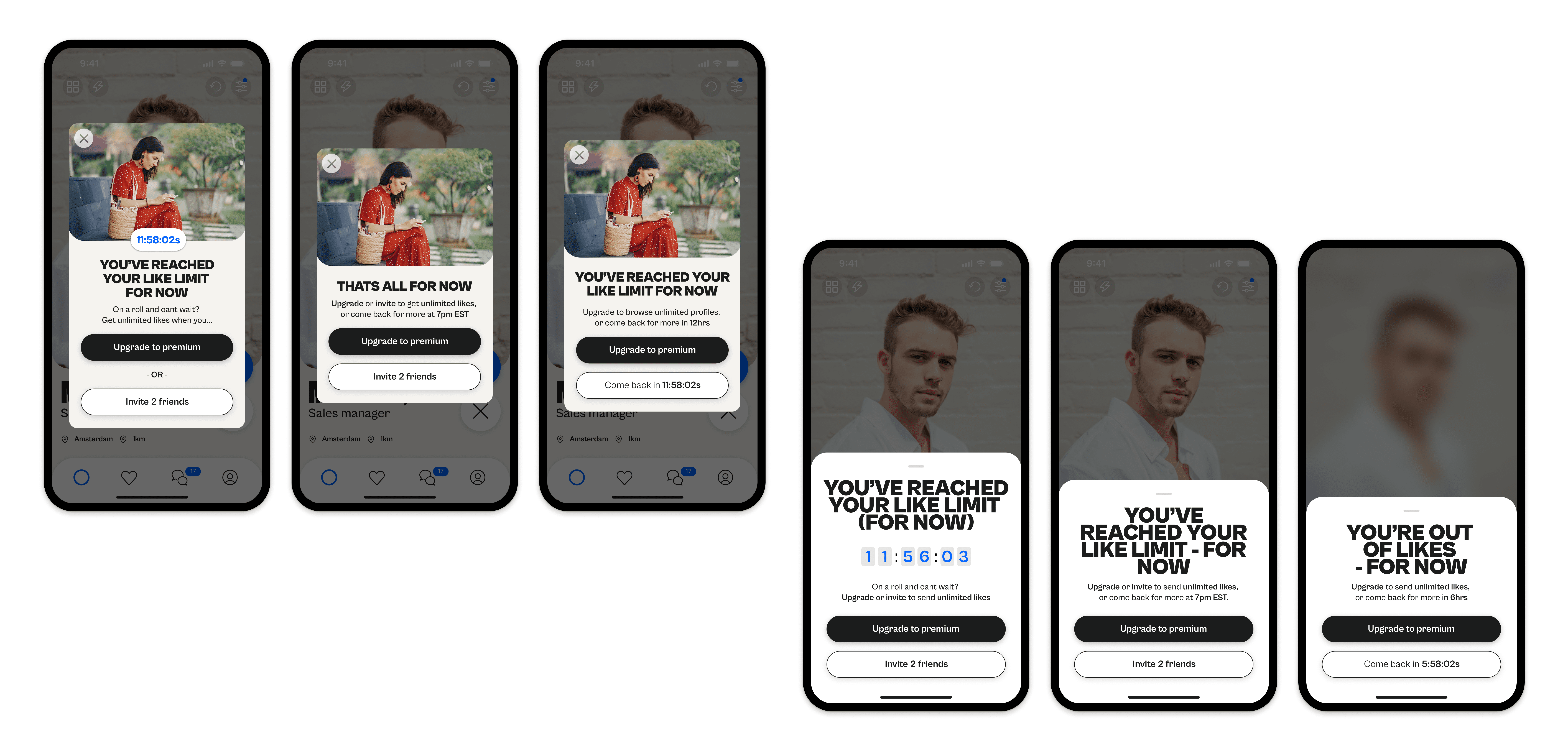
1. View paywall variations: testing time limits, different copy, different paywall UI Like paywall 2. Like paywall variations: testing time limits, invites, different copy, different paywall UI

Outcome —
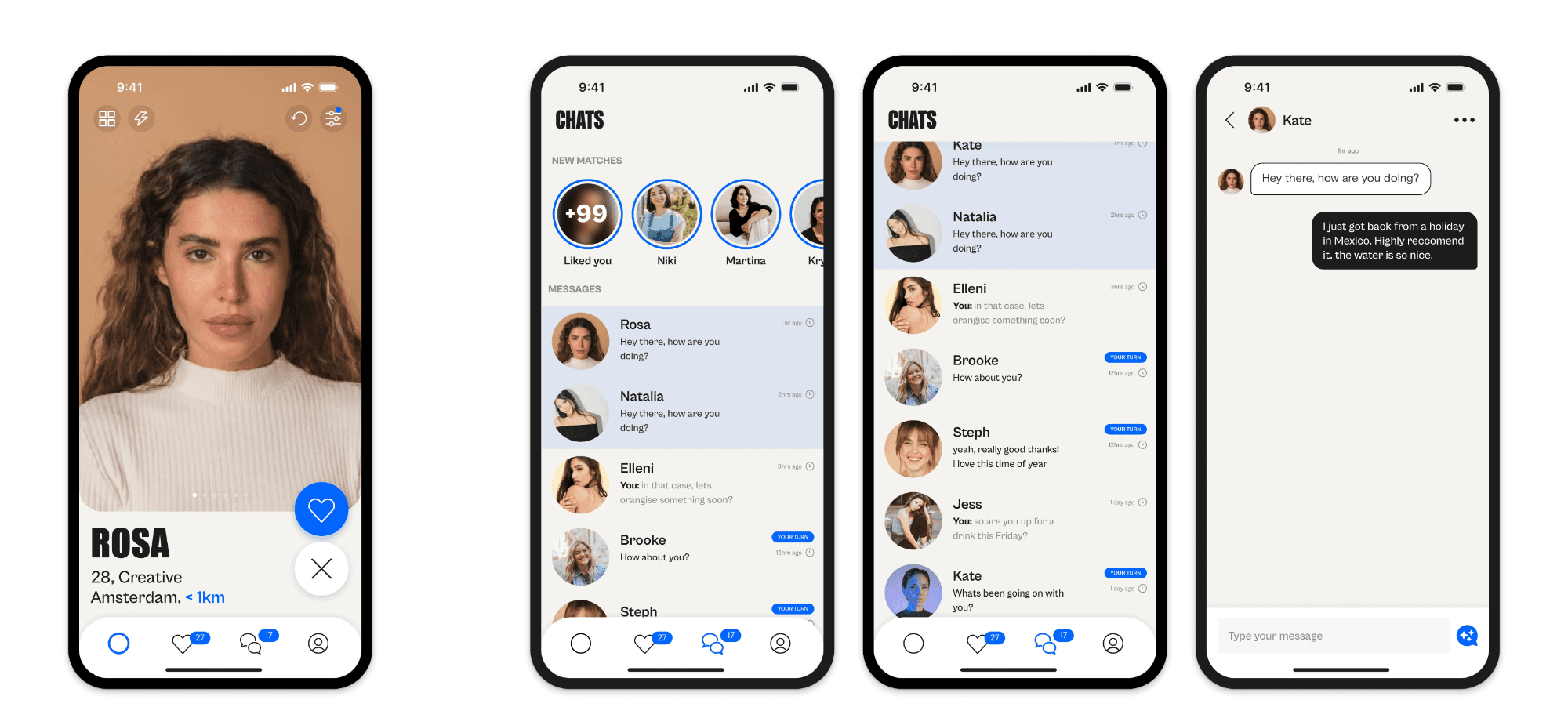
Like-limiting paywalls became our default in emerging and high-churn markets.

The best-performing variation (open messages + limited likes with 12-hour reset + invite unlocks) boosted new user engagement, increased first-week activity and DAU retention, reduced churn in targeted markets, and supported invite-driven growth loops; helping us reach the critical 10K DAU threshold for network effects.

Like-limiting paywalls became our default in emerging and high-churn markets.

The best-performing variation (open messages + limited likes with 12-hour reset + invite unlocks) boosted new user engagement, increased first-week activity and DAU retention, reduced churn in targeted markets, and supported invite-driven growth loops; helping us reach the critical 10K DAU threshold for network effects.

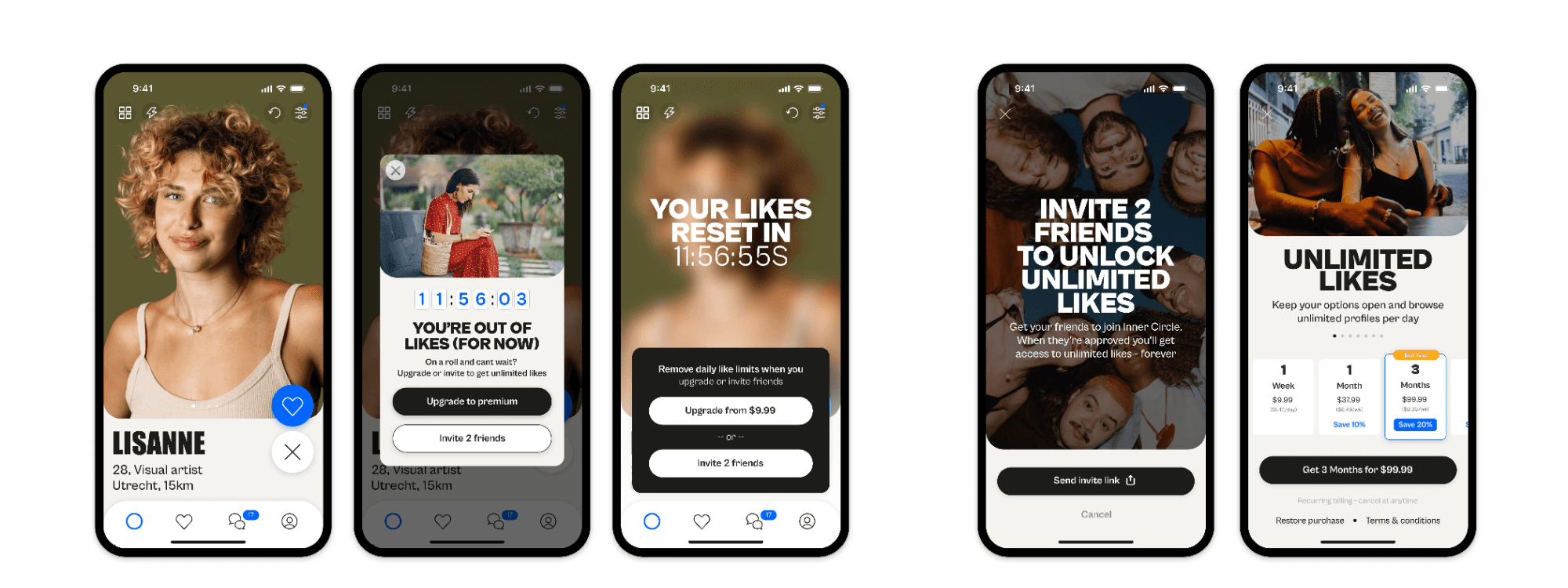
Final UI: Open messages

Final UI: Above: Open messages. Below: Limited likes with 12hr reset, and invite 2 friends to unlock unlimited likes,

Takeaway —

In core, revenue-dependent markets, the original message-locked paywall still outperformed, demonstrating the importance of optimizing for context:

Engagement first in emerging markets, conversion in mature markets.

In core, revenue-dependent markets, the original message-locked paywall still outperformed, demonstrating the importance of optimizing for context:

Engagement first in emerging markets, conversion in mature markets.

Get in touch

I'm currently available from January 2026, for full-time or Freelance projects in Amsterdam or remote, and open to relocation within the EU or UK.

Billie Gray - 2026

Amsterdam, NL

Get in touch

I'm currently available from January 2026, for full-time or Freelance projects in Amsterdam or remote, and open to relocation within the EU or UK.

Billie Gray - 2026

Amsterdam, NL

Get in touch

I'm currently available from January 2026, for full-time or Freelance projects in Amsterdam or remote, and open to relocation within the EU or UK.

Billie Gray - 2026

Amsterdam, NL